
Yap's money stones and the lesson of Bitcoin
Yap's money stones and the lesson of Bitcoin
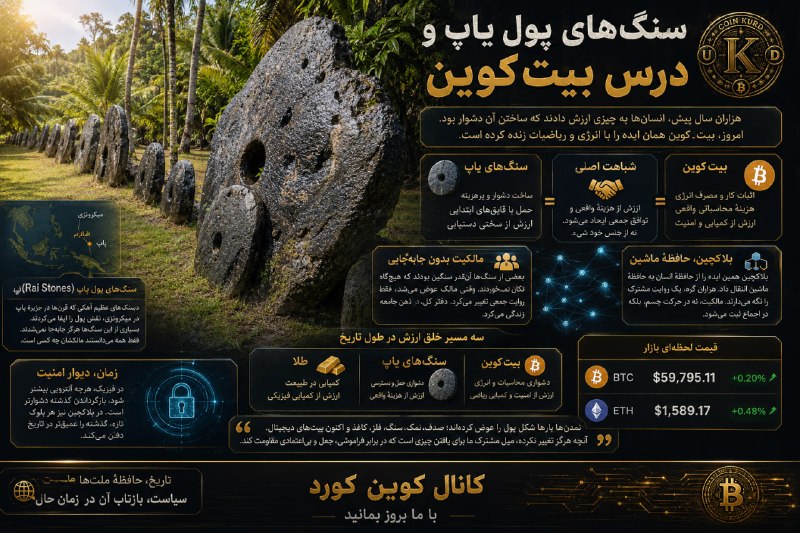
This image shows a row of Yap's money stones (Rai Stones); huge limestone discs that for centuries served as money on the island of Yap, in Micronesia. The hole in their center was for carrying them on a wooden pole, but here is the irony of history: many of these stones were never moved. Everyone simply knew who owned them.
So perhaps this image, more than any price chart, speaks about Bitcoin.
--- If you understand these stones, Bitcoin is no longer just a “digital asset”; rather, it is the continuation of a story that began thousands of years ago.
These stone discs were not valuable because they were made of stone. Stone can be found everywhere. Their value was born of something else: the cost of creation.
To make a single Rai stone, the people of Yap had to travel hundreds of kilometers in primitive boats to other islands, quarry limestone, and bring it back across the ocean. Sometimes someone lost their life on this journey. That death became part of the stone's value. A cost that could not be faked.
Bitcoin follows the same logic, but instead of the ocean, it passes through electricity and mathematics. Proof of work engraves a story in the heart of every block: “Real energy was consumed for me to come into existence.” Energy turns into memory.
But the bigger secret lies elsewhere.
Some of the Yap stones were so heavy that they never budged from their place. When the owner changed, only the collective narrative changed. Everyone knew to whom this stone now belonged. The ledger was not on paper; it lived in the mind of the community.
Blockchain moved this same idea from human memory to machine memory. You no longer need to trust people's memory; thousands of nodes keep a shared narrative. Ownership is recorded not in the movement of an object, but in consensus.
From afar, these stones are silent. But if you look closely, each of them whispers a sentence:
“Money is not an object; it is an agreement.”
Gold achieved this agreement through scarcity.
The Yap stones, through the difficulty of carrying them.
Bitcoin, through computations that make rewriting the past almost impossible.
In physics, the more entropy increases, the harder it is to restore the past. In blockchain, too, every new block buries the past deeper in history. Time becomes a wall of security.
Perhaps that is why this image speaks more about humans than about stone.
Civilizations have changed the form of money many times: shells, salt, stone, metal, paper, and now digital bits. What has never changed is our shared desire to find something that can withstand forgetting, forgery, and distrust.
The stones did not endure because they were hard.
They endured because humans decided to carry a shared truth on their shoulders.
Bitcoin, too, is ultimately not made of code; it is made of that same decision. The only difference is that this time, its memory is engraved not in the mind of a tribe, but in a global network.
#Bitcoin #Rai_stone #money #collective_agreement
Persian original · View this post on Telegram ↗ · Open in the archive · 💬 Discuss in the Coin_Kurd Telegram group · Educational, not financial advice.