
Conflict of interest in Trump's billion-dollar crypto income 💼
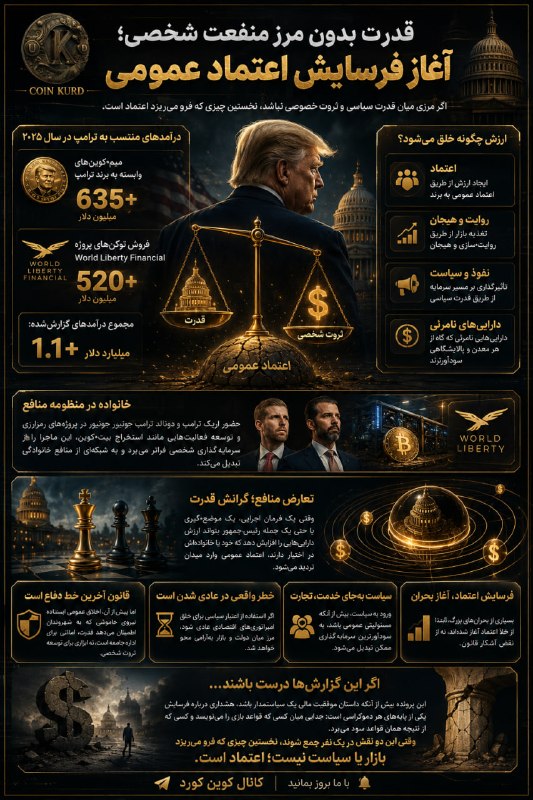
Conflict of interest in Trump's billion-dollar crypto income 💼
Power, if it has no boundary with personal gain, is like a river that slowly swallows its own bed. Disaster does not begin when the first dollar is deposited into an account; it begins the moment people can no longer tell whether a decision was made for the public good or to increase the value of the decision-maker's assets.
If the published figures on the 2025 financial disclosure are correct, the issue is no longer merely Donald Trump getting richer. It is about a phenomenon that puts one of the most fundamental walls of governance to the test; the very wall that should stand between political power and private wealth.
Reports speak of more than $635 million in income attributed to memecoins linked to the Trump brand and more than another $520 million from sales of tokens of the World Liberty Financial project; a figure that crosses the $1.1 billion mark. The decisive point is not the size of the number. The question is how this value was created. Here, no factory has been built, no new technology has pushed the frontiers of knowledge, and the economy's productivity has not leapt forward. A large part of this value feeds on something we have seen many times in financial markets: trust, excitement, narrative and influence; invisible assets that sometimes become more profitable than any mine or refinery.
But the picture becomes more complete when the family also becomes part of this same economic constellation. The presence of Eric Trump and Donald Trump Jr. in cryptocurrency projects and the expansion of activities such as Bitcoin mining take this affair beyond a personal investment and tie it to a network of family interests; a network operating in a market where any change in public policy can shift billions of dollars of its value.
Here, conflict of interest is no longer a dry legal term; it becomes an issue akin to the physics of gravity. Just as a planet's mass bends the paths of the bodies around it, political power also changes the path of capital. When an executive order, a stance or even a single sentence from the president can increase the value of assets that he or his family hold, public trust enters the realm of doubt. Even if no criminal law has been broken, the question still remains: was the decision made for the country or for an investment portfolio?
The law is not always the last line of defense. Before it stands public ethics; the same silent force that assures citizens that power is a trust for running society, not a tool for growing personal wealth. History has shown many times that many great crises began first from a vacuum of trust, not from an open violation of the law.
Nor is the real danger confined to the billion-dollar figure itself. The danger is the day this pattern becomes normal. If using political credibility to create economic empires becomes accepted behavior, the boundary between government and market will gradually fade away. Then entering politics, rather than being a public responsibility, becomes the most profitable investment possible; a market in which the people's vote is the seed capital and power is the engine for increasing the value of assets.
If these reports accurately reflect reality, this case is less the story of a politician's financial success than a warning about the erosion of one of the pillars of any democracy: the separation between the one who writes the rules of the game and the one who profits from the outcome of those same rules. When these two roles are combined in one person, the first thing to collapse is not the market or politics; it is trust. And a society that loses its trust will sooner or later pay a price that no balance sheet can calculate.
Persian original · View this post on Telegram ↗ · Open in the archive · 💬 Discuss in the Coin_Kurd Telegram group · Educational, not financial advice.