
Continuing this philosophical narrative and the ongoing dissection of Satoshi Nakamoto's foundational ideas, we reach the deepest layer of the encounter…
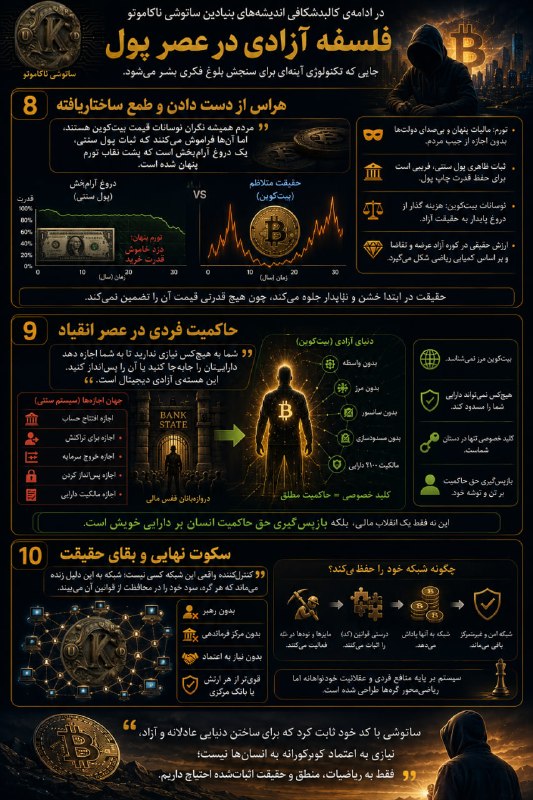
Continuing this philosophical narrative and the ongoing dissection of Satoshi Nakamoto's foundational ideas, we reach the deepest layer of this system's encounter with mass psychology; where technology becomes a mirror for measuring humanity's intellectual maturity.
8. The fear of loss and structured greed
“People are always worried about Bitcoin's price volatility, but they forget that the stability of traditional money is a soothing lie hidden behind the mask of inflation.”
Human society has grown used to seeing stability in a fixed number on a banknote, even if that number's purchasing power melts away every year and swallows the value of people's hard work. This is a structural deception; inflation is a hidden, silent tax that governments steal from the pockets of nations without permission. Bitcoin shatters this comforting illusion. Bitcoin's price volatility along this path is the painful cost of the transition from a stable lie to a turbulent but liberating truth. The truth at first appears harsh and unstable because, unlike government printing presses, no one guarantees its price by decree; its value crystallizes in the free furnace of supply and demand and on the basis of mathematical scarcity.
9. Individual sovereignty in the age of subjugation
“You do not need anyone to give you permission to move your assets or to save them. This is the core of digital freedom.”
All of modern history has been built on “asking permission”; permission to open an account, permission to move capital across borders, and permission to keep the fruits of one's labor. Banks and governments act as the gatekeepers of this cage, and for every transaction they demand a share of your economic lifeblood. By designing a structure in which the private key is held only by the individual, Satoshi overthrew this historical monopoly. In this protocol, borders have no meaning, censorship is meaningless, and no centralized power can freeze anyone's assets. This is not just a financial revolution, but the reclaiming of humanity's right to sovereignty over its own life and possessions.
10. The final silence and the survival of truth
“The true controller of this network is no one; the network stays alive because every node sees its own benefit in protecting its rules.”
This is Satoshi's masterpiece of social and economic engineering. He did not build the system in a way that would need moralism, sacrifice or heroes to survive; rather, he founded it on the individual interests and the selfish yet mathematics-driven rationality of the nodes. Miners and nodes protect the network not because they love Satoshi, but because the protocol rewards them for proving the correctness of the code. This is how a system without a boss, without a command center and without the need for trust lives on, stronger than all the armies and central banks of the world.
#Satoshi_Nakamoto #philosophy_of_money #Bitcoin #individual_sovereignty
Persian original · View this post on Telegram ↗ · Open in the archive · 💬 Discuss in the Coin_Kurd Telegram group · Educational, not financial advice.