
🔥 Two Data Leaks in Three Days; The Main Threat to Hardware Wallets Might Not Be the Blockchain Itself
🔥 Two Data Leaks in Three Days; The Main Threat to Hardware Wallets Might Not Be the Blockchain Itself
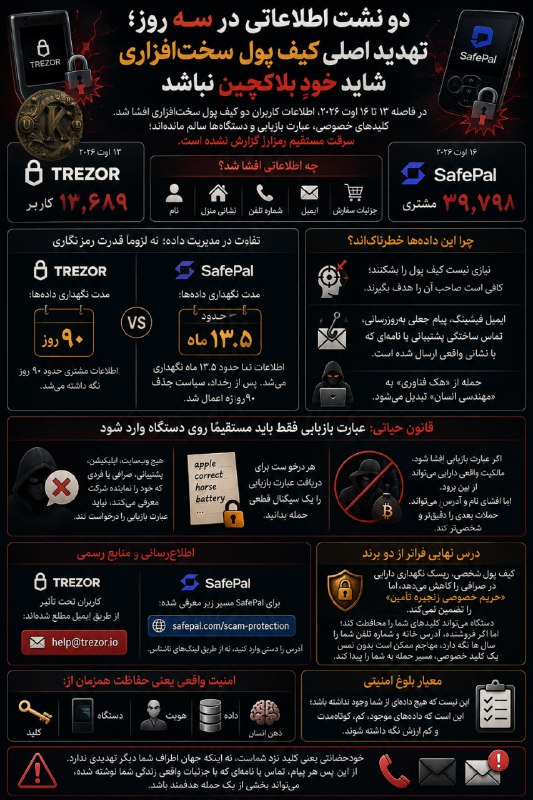
Between August 13 and 16, two security incidents in the hardware wallet ecosystem revealed an important reality: cryptocurrency security is not limited to device cryptography; the owner's digital footprint can also become an attacker's entry point.
On August 13, the information of 13,689 Trezor users and on August 16, the information of 39,798 SafePal customers were exposed. However, according to the text of the report, the Seed Phrase, private keys, and the devices themselves were not compromised, and no direct cryptocurrency theft was reported. What was exposed includes information such as name, home address, phone number, email, and order details. 🧐
The deeper point is the difference in "data management", not necessarily cryptographic strength. Trezor kept customer information for about 90 days, while SafePal retained data for up to about 13.5 months, and after the incident, applied a 90-day deletion policy. This means sometimes the smallest layer of a system is not the encryption wall, but the duration personal information remains. 💡
This data may be more valuable than imagined. The attacker no longer needs to directly break the wallet; it is enough to target its owner: a phishing email, a fake update message, a bogus support call, or even a letter sent to the real address. At this stage, the attack shifts from "technology hacking" to "social engineering". 📉
The vital rule is simple: The Seed Phrase should only be entered directly on the device itself; no website, application, support, exchange, or individual introducing themselves as a company representative should ask for it. Any request to receive the recovery phrase must be considered a definitive attack signal. If this phrase is exposed, the true ownership of the asset can be lost; but exposing the name and address can also make subsequent attacks more precise and personal.
Affected Trezor users have been notified via email at [help@trezor.io](mailto:help@trezor.io) according to the text. For SafePal, the path safepal.com/scam-protection has been introduced and it is recommended to enter the address manually, not through unknown links. 🔐
The final lesson goes beyond two brands: a personal wallet reduces the risk of holding assets on an exchange, but it does not guarantee "supply chain privacy". The device can protect your keys; but if the vendor keeps your home address and phone number for years, an attacker might find a way to attack you without touching a private key. True security means simultaneous protection of assets, keys, and identity. 🔥
#cryptocurrency_security #hardware_wallet #Bitcoin #phishing self-custody means the key is with you, not that the world around you no longer has threats. From now on, any message, call, or letter written with the real details of your life can be part of a targeted attack. 🛡 The benchmark of security maturity is not that no data about you exists; it is that existing data is kept minimal, short-term, and low-value. Any data that seems necessary for a purchase today may be used to deceive you tomorrow. View security as a chain: key, device, identity, data, and the human mind. If one collapses, the path to another opens. 🔥
Between August 13 and 16, two security incidents in the hardware wallet ecosystem revealed an important reality: cryptocurrency security is not limited to device cryptography; the owner's digital footprint can also become an attacker's entry point.
On August 13, the information of 13,689 Trezor users and on August 16, the information of 39,798 SafePal customers were exposed. However, according to the text of the report, the Seed Phrase, private keys, and the devices themselves were not compromised, and no direct cryptocurrency theft was reported. What was exposed includes information such as name, home address, phone number, email, and order details. 🧐
The deeper point is the difference in "data management", not necessarily cryptographic strength. Trezor kept customer information for about 90 days, while SafePal retained data for up to about 13.5 months, and after the incident, applied a 90-day deletion policy. This means sometimes the smallest layer of a system is not the encryption wall, but the duration personal information remains. 💡
This data may be more valuable than imagined. The attacker no longer needs to directly break the wallet; it is enough to target its owner: a phishing email, a fake update message, a bogus support call, or even a letter sent to the real address. At this stage, the attack shifts from "technology hacking" to "social engineering". 📉
The vital rule is simple: The Seed Phrase should only be entered directly on the device itself; no website, application, support, exchange, or individual introducing themselves as a company representative should ask for it. Any request to receive the recovery phrase must be considered a definitive attack signal. If this phrase is exposed, the true ownership of the asset can be lost; but exposing the name and address can also make subsequent attacks more precise and personal.
Affected Trezor users have been notified via email at [help@trezor.io](mailto:help@trezor.io) according to the text. For SafePal, the path safepal.com/scam-protection has been introduced and it is recommended to enter the address manually, not through unknown links. 🔐
The final lesson goes beyond two brands: a personal wallet reduces the risk of holding assets on an exchange, but it does not guarantee "supply chain privacy". The device can protect your keys; but if the vendor keeps your home address and phone number for years, an attacker might find a way to attack you without touching a private key. True security means simultaneous protection of assets, keys, and identity. 🔥
#cryptocurrency_security #hardware_wallet #Bitcoin #phishing self-custody means the key is with you, not that the world around you no longer has threats. From now on, any message, call, or letter written with the real details of your life can be part of a targeted attack. 🛡 The benchmark of security maturity is not that no data about you exists; it is that existing data is kept minimal, short-term, and low-value. Any data that seems necessary for a purchase today may be used to deceive you tomorrow. View security as a chain: key, device, identity, data, and the human mind. If one collapses, the path to another opens. 🔥
Persian original · View this post on Telegram ↗ · Open in the archive · 💬 Discuss in the Coin_Kurd Telegram group · Educational, not financial advice.