
⚠️ When trust breaks, the financial system shakes
⚠️ When trust breaks, the financial system shakes
Background | Cracks that go unseen before collapse
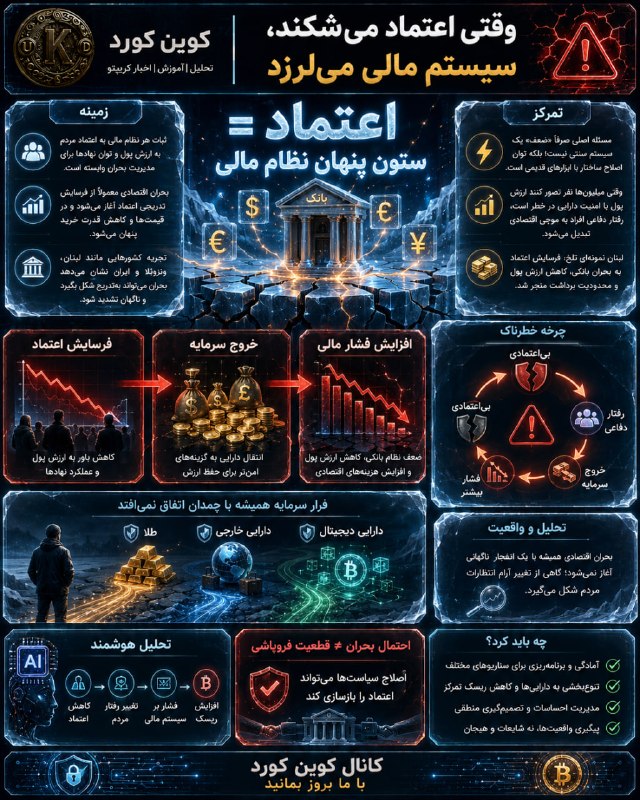
An economic system is not merely a collection of banks, currencies and laws; it is a network of trust. As long as people believe their money will hold its value and institutions are capable of managing crises, the system can withstand heavy pressure. But if that trust disappears, the very structure that seemed stable for years can suddenly face a wave of capital flight and defensive behavior.
The experience of countries such as Lebanon, Venezuela and Iran shows that an economic crisis is usually not an instant explosion; sometimes it forms gradually, hides in prices and declining purchasing power, and then accelerates as public expectations shift.
Focus | The point where fear itself becomes an economic force
⚡️ The core issue is not simply the "weakness" of a traditional system; the more important question is whether a structure facing new problems with old tools truly has the capacity to reform, or is merely buying time.
📊 The danger becomes more serious when a shared picture forms in the minds of millions: "If the value of my money or the safety of my assets is at risk, I must decide before everyone else." This is where a psychological phenomenon turns into an economic problem; individuals act to save their capital, and the sum of these individual decisions can increase pressure on the entire system.
💰 Lebanon was a bitter example of this very logic; when trust in the financial system eroded, withdrawal limits, currency devaluation and the banking crisis were not separate problems but links in a single chain. In such conditions, "money" is no longer just a medium of exchange; it becomes a gauge of society's confidence in the future.
Implications | Capital flight doesn't always happen with a suitcase
🪙 When trust declines, people may turn to assets they believe are more resilient against inflation, currency devaluation or the restrictions of the financial system—from gold and foreign assets to digital instruments and decentralized networks.
🔻 On the other hand, capital outflows and declining trust can put further strain on the financial system's capacity. This is the dangerous loop: distrust breeds defensive behavior; defensive behavior creates pressure; and greater pressure reinforces distrust.
But there is one vital point: the "possibility of a crisis" is not the same as the "certainty of collapse." Economies can be reformed, policies can change and trust can be rebuilt. So the real warning is not a call to panic; it is a call to understand risk.
Conclusion | Close the window before the storm
If trust is the main pillar of a financial system, the greatest asset in times of crisis is not prophecy, but preparedness, diversification and the ability to tell reality from hype; because economic collapse may begin somewhere that doesn't show up on the charts: in people's minds. 🎯
#Economy #Financial_Crisis #Traditional_System #Capital_Preservation
Persian original · View this post on Telegram ↗ · Open in the archive · 💬 Discuss in the Coin_Kurd Telegram group · Educational, not financial advice.