
🪙 The neutrality dispute: the big test of Bitcoin's future
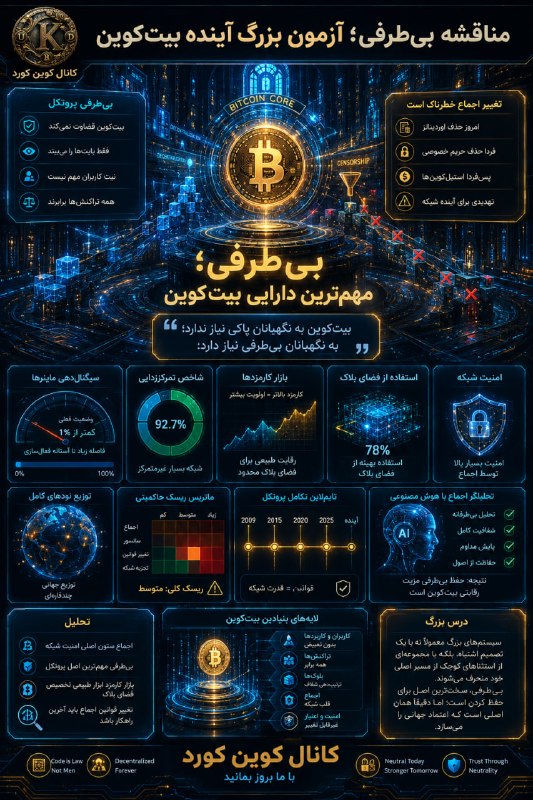
🪙 The neutrality dispute: the big test of Bitcoin's future
Sometimes the biggest threat to a system does not come from outside; it begins the moment the system decides to distance itself from its own principles in order to solve a problem.
This is exactly the point that has turned the debate around BIP 110 into one of the most important debates in Bitcoin in recent years. Many people think the disagreement is about Ordinals or Runes, but if we look a little deeper, we see that the issue is far more fundamental than that. The real question is not “whether this data is useful or not”;
the question is: who has the right to decide what purpose Bitcoin should be used for?
Michael Saylor raises his opposition from a different angle; an angle that, in my opinion, deserves more reflection. He is not defending Ordinals; rather, he is defending the neutrality of the protocol. In his view, Bitcoin should not pass judgment on users' intentions. The blockchain sees only bytes, not the motives behind them. What some people call “spam” today may tomorrow be the infrastructure of a financial innovation that we have not even imagined yet.
I always tell my students this: the biggest mistake in technology is judging the future by today's standards. The history of the internet is full of examples of emerging technologies that were considered useless or even a nuisance at the start of their journey. If someone back then had decided to eliminate them based solely on their initial use, many of the services we take for granted today would never have been born.
Of course, this does not mean that the critics' concerns are baseless. The occupation of block space, rising fees and pressure on nodes are real concerns. But the fundamental question is this:
Should every problem be solved by changing the consensus rules?
Consensus is the heart of Bitcoin. It is the very layer on which the network's security, limited supply and the validity of transactions are built. Any change to this layer should be for threats that endanger the network's existence; not for disagreements over which uses we like and which we don't. If today we change consensus to eliminate one type of transaction, what guarantee is there that tomorrow another group will not ban another use? Today the target may be Ordinals, tomorrow privacy tools, the day after that stablecoins, or any use that does not match the majority's taste.
This is where Saylor's statement takes on a deeper meaning: “Bitcoin does not need guardians of purity; it needs guardians of neutrality.” This statement is not just a slogan; it is a summary of the philosophy on which Bitcoin was built. A protocol that is meant to be global cannot operate according to the likes or dislikes of a particular group.
On the other hand, we should not forget that Bitcoin has had mechanisms for managing its limited resources from the very beginning. Block space is not free; the fee market determines who is willing to pay more to use it. Miners, too, decide which transactions to include in a block based on economic incentives. This means the network itself has tools for adjusting the balance, without its fundamental rules needing to be rewritten.
What is even more interesting is that even if BIP 110 is approved, there will probably be technical ways to get around many of its restrictions. In other words, the cost to innovation may be permanent, while the expected result may not be fully achieved either. This is exactly where we should ask ourselves:
Is it worth weakening the principle of protocol neutrality to solve a problem that may not even be fully solved?
At present, too, this issue should not be blown out of proportion. Miner signaling is still below one percent and is very far from the activation threshold. So what we see today is less an imminent fork than a philosophical debate about Bitcoin's future; a debate that will determine how this network evolves in the coming decades.
The lesson I want you to take away from this story is not only about Bitcoin.
Whenever you see that, in order to solve a short-term problem, it is proposed to set aside one of a system's fundamental principles, pause. History has shown that large systems usually drift from their main path not through a single wrong decision, but through a series of small exceptions. Each exception seems logical in its own time, but when they are put together, they change the original identity of that system.
Bitcoin's real power is not only in its scarcity; it lies in the fact that its rules are applied equally to everyone, even to transactions that many people may not like.
#my_view
Persian original · View this post on Telegram ↗ · Open in the archive · 💬 Discuss in the Coin_Kurd Telegram group · Educational, not financial advice.