
🚨 Iran on the Brink of Severe Inflation — Not Yet Hyperinflation!
🚨 Iran on the Brink of Severe Inflation — Not Yet Hyperinflation!
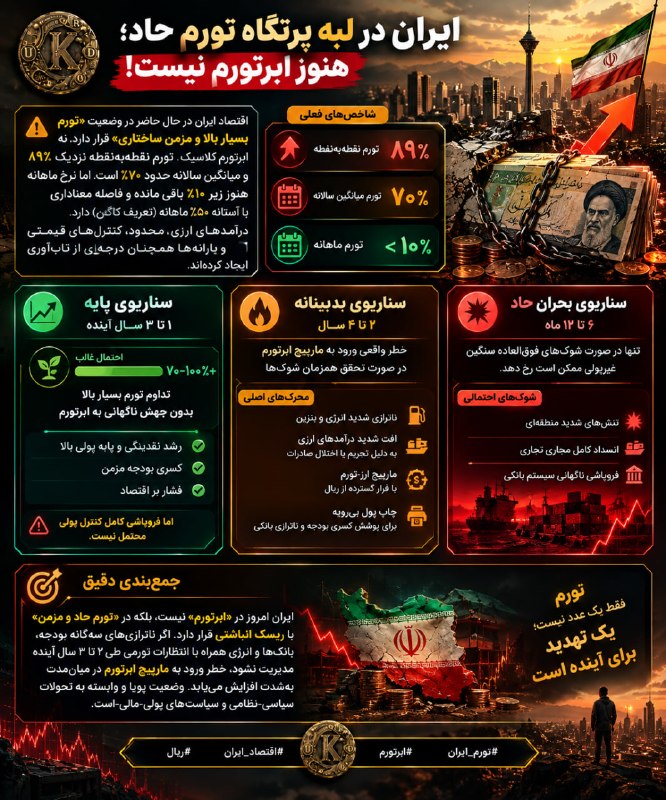
Iran's economy is currently in a state of “very high, chronic structural inflation,” not classic hyperinflation. Year-on-year inflation is close to 89% and the annual average around 70%, but the monthly rate remains below 10%, well short of the 50% monthly threshold (Cagan's definition). Limited foreign-currency revenues, price controls and subsidies still provide a degree of resilience.
Base scenario (next 1–3 years): The dominant probability is continued very high inflation (70–100%+) without a sudden leap into hyperinflation. Growth in liquidity and the monetary base, along with chronic budget deficits, keeps up the pressure, but a complete collapse of monetary control is unlikely.
Pessimistic scenario (2–4 years): There is a real risk of entering a hyperinflationary spiral if shocks coincide. The main drivers include severe energy and gasoline imbalances, a sharp drop in foreign-currency revenues due to sanctions or export disruptions, a currency-inflation spiral with widespread flight from the rial, and excessive money printing to cover the budget deficit and banking imbalances.
Acute short-term crisis scenario (6–12 months): This could occur only in the event of extremely severe non-monetary shocks, such as intense regional tensions, a complete blockage of trade channels, or a sudden collapse of the banking system.
Precise summary: Iran today is not in “hyperinflation” but in “severe, chronic inflation” with accumulating risk. If the threefold imbalances of the budget, banks and energy, together with inflation expectations, are not managed over the next 2–3 years, the risk of entering a hyperinflationary spiral in the medium term rises sharply. The situation is dynamic and depends on political-military developments and monetary-fiscal policy.
#Iran_Inflation #Hyperinflation #Iran_Economy #Rial
Iran's economy is currently in a state of “very high, chronic structural inflation,” not classic hyperinflation. Year-on-year inflation is close to 89% and the annual average around 70%, but the monthly rate remains below 10%, well short of the 50% monthly threshold (Cagan's definition). Limited foreign-currency revenues, price controls and subsidies still provide a degree of resilience.
Base scenario (next 1–3 years): The dominant probability is continued very high inflation (70–100%+) without a sudden leap into hyperinflation. Growth in liquidity and the monetary base, along with chronic budget deficits, keeps up the pressure, but a complete collapse of monetary control is unlikely.
Pessimistic scenario (2–4 years): There is a real risk of entering a hyperinflationary spiral if shocks coincide. The main drivers include severe energy and gasoline imbalances, a sharp drop in foreign-currency revenues due to sanctions or export disruptions, a currency-inflation spiral with widespread flight from the rial, and excessive money printing to cover the budget deficit and banking imbalances.
Acute short-term crisis scenario (6–12 months): This could occur only in the event of extremely severe non-monetary shocks, such as intense regional tensions, a complete blockage of trade channels, or a sudden collapse of the banking system.
Precise summary: Iran today is not in “hyperinflation” but in “severe, chronic inflation” with accumulating risk. If the threefold imbalances of the budget, banks and energy, together with inflation expectations, are not managed over the next 2–3 years, the risk of entering a hyperinflationary spiral in the medium term rises sharply. The situation is dynamic and depends on political-military developments and monetary-fiscal policy.
#Iran_Inflation #Hyperinflation #Iran_Economy #Rial
Persian original · View this post on Telegram ↗ · Open in the archive · 💬 Discuss in the Coin_Kurd Telegram group · Educational, not financial advice.